
Data quality tests
After this page, you will be able to declare tests in etl_config.yaml and run them with bolt test. You will also know how pass or fail status is exposed for CI and notebooks.
All behavior on this page is verified against bolt-pipeliner==0.2.6.
Where tests live
Tests are declared per job under the tests: key.
silver:
  - module: silver_customer_features
    class_name: ETLBaseParquetPandas
    input_tables:
      customers: bronze_customers
    output_table_name: customer_features
    tests:
      - not_null: [customer_id, year_month]
      - unique: [customer_id, year_month]
      - row_count: {min: 1, max: 1000000}
      - schema: [customer_id, year_month, segment]
      - freshness: {column: year_month, max_age_days: 90}
Each list item is one check spec. Use either a one key mapping with parameters, or a plain string when a check accepts defaults.
Run tests
bolt test [--config PATH] [--layer LAYER] [--module MODULE]Common patterns:
# Run all tests in the project config.
bolt test

# Run only one layer.
bolt test --layer silver

# Run one module in one layer.
bolt test --layer silver --module customer_features
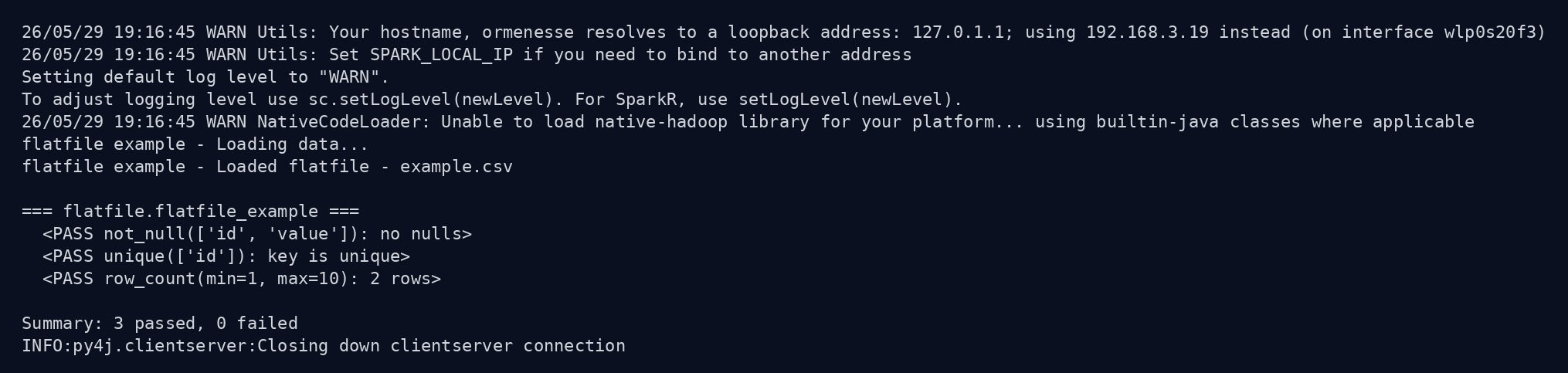
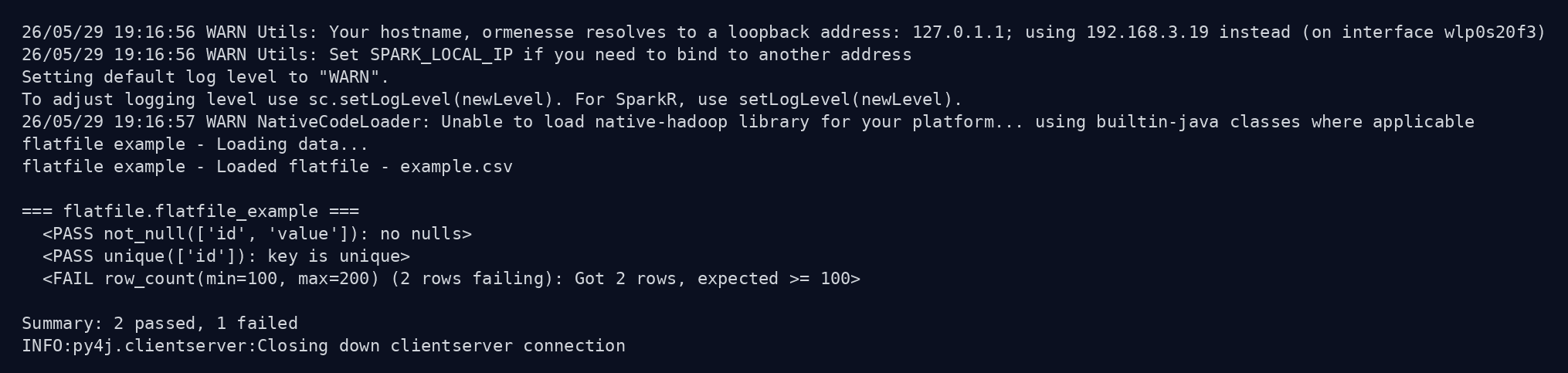
bolt test returns exit code 0 when all checks pass. It returns exit code 1 when any check fails, which is the behavior you want for CI pipelines.
Passing run with PASS banners:
Failing run with a FAIL banner:
Built-in checks
bolt-pipeliner==0.2.6 supports five checks.
not_null
YAML form:
- not_null: [col_a, col_b]Parameters passed to the check function:
columns: list of columns that must be non null
The check fails if any listed column is missing, or if any row has a null in those columns.
unique
YAML form:
- unique: [col_a, col_b]Parameters passed to the check function:
columns: list of columns that define a composite unique key
The check fails when duplicate key combinations exist.
row_count
YAML form:
- row_count: {min: 1, max: 1000000}Parameters passed to the check function:
min: minimum allowed row count, default is1max: optional maximum allowed row count
The check fails if the DataFrame row count falls outside the allowed range.
schema
YAML form:
- schema: [customer_id, year_month, segment]Parameters passed to the check function:
expected: list of required columns
The check validates presence of expected columns. Extra columns are allowed.
freshness
YAML form:
- freshness: {column: year_month, max_age_days: 90}Parameters passed to the check function:
column: field used to evaluate recencymax_age_days: maximum allowed age in days
The check accepts either:
- a
YYYYMMinteger style value incolumn - a date or datetime style value in
column
It fails when the latest value in the column is older than max_age_days.
Parameter coercion rules
The test runner normalizes shorthand YAML into function parameters:
not_null: [a, b]becomescolumns=[a, b]unique: [a, b]becomescolumns=[a, b]schema: [a, b]becomesexpected=[a, b]row_count: {min: 1, max: 10}is passed through as isfreshness: {column: year_month, max_age_days: 90}is passed through as is
Notebook and HTML rendering
Each check returns a TestResult object with PASS or FAIL status, details text, and optional failed row count.
In notebook contexts, TestResult implements _repr_html_(), so each result renders as inline HTML with colored pass or fail labels.
The testing runner also includes render_html(results), which joins that HTML output into one block for display.